







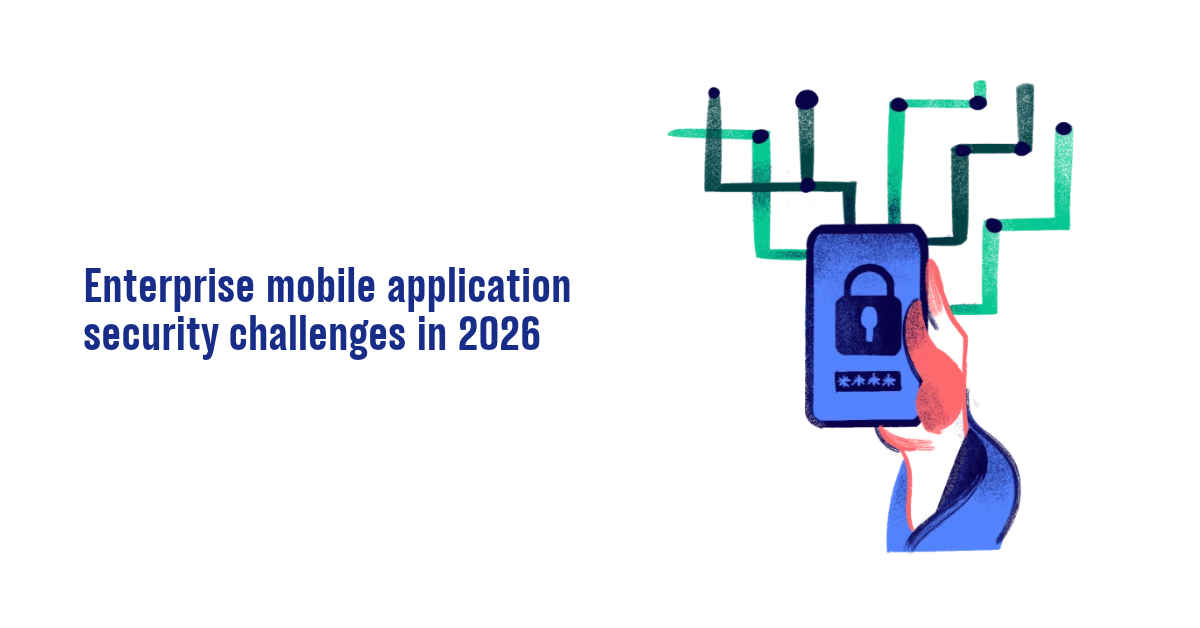
Enterprise mobile application security challenges in 2026
Key takeaway | Details |
Main risks | Weak authentication, insecure APIs, exposed data, and vulnerable software |
Business impact | Data theft, account compromise, service disruption, and regulatory penalties |
Key controls | Encryption, access restrictions, security testing, and threat monitoring |
U.S. compliance | HIPAA, GLBA, and applicable state privacy laws |
Enterprise mobile apps connect employees, customers, and business systems. A single security flaw can expose sensitive data, disrupt operations, and damage customer trust.
Why do enterprise mobile apps face security risks?
Enterprise mobile application security challenges affect applications that handle customer records, financial transactions, employee information, and internal business processes. Each connection between an app, device, API, and backend system can create an entry point for attackers.
The primary risks include:
- Weak authentication: Stolen credentials and poorly protected sessions can expose business accounts.
- Insecure APIs: Weak authorization checks can allow users to access records beyond their permissions.
- Unsafe data storage: Apps may expose sensitive information through logs, caches, or unprotected files.
- Vulnerable dependencies: Outdated third-party libraries can introduce security flaws.
- Compromised devices: Lost phones and unsupported operating systems can increase the risk of unauthorized access.
These mobile app security risks for U.S. businesses require controls across applications, devices, networks, and cloud services.
How do U.S. regulations affect mobile app security?
Mobile application cybersecurity challenges in the United States involve both technical threats and legal obligations. Organizations must identify the rules that apply to their industries, data, and business activities.
Key requirements include:
- HIPAA: Covered entities and business associates must protect electronic protected health information under applicable Security Rule requirements.
- GLBA: Covered financial institutions must safeguard customer information under applicable requirements.
- CCPA, as amended by the CPRA: Covered businesses must meet relevant California privacy obligations.
- State breach notification laws: Organizations must assess notification duties after qualifying data breaches.
- PCI DSS: Organizations that handle payment card data must meet applicable security requirements.
Compliance teams should assess each obligation separately. One security framework does not automatically satisfy every legal requirement.
Which security practices should enterprises prioritize?
Enterprise app security best practices for U.S. organizations should cover the entire application lifecycle, from initial development to ongoing maintenance. For wider planning, organizations can review enterprise application security trends when setting internal security standards.
How should companies protect identities and data?
Security teams should apply the following controls:
- Require multifactor authentication for sensitive accounts and high-risk actions.
- Enforce role-based access control and least-privilege permissions.
- Encrypt sensitive data in transit using current TLS configurations.
- Protect stored data with platform security features, such as the iOS Keychain and Android Keystore.
- Keep passwords, private keys, and API secrets out of application code.
- Validate permissions on the server for every sensitive request.
- Limit sensitive information in application logs and analytics systems.
Teams should also set session timeouts, revoke compromised tokens, and require additional verification for sensitive transactions.
How can companies detect and fix mobile vulnerabilities?
Mobile app vulnerability management for U.S. companies requires a repeatable process to identify flaws, prioritize risks, apply fixes, and verify results.
A practical testing process includes:
- Threat modeling: Identify sensitive data, trust boundaries, and potential attack paths.
- Static application security testing (SAST): Scan source code for security defects.
- Software composition analysis (SCA): Identify vulnerable third-party dependencies.
- Dynamic application security testing (DAST): Test running applications and supporting services.
- Penetration testing: Assess whether attackers can exploit identified weaknesses.
- Remediation: Fix high-risk findings and retest affected components.
Organizations can use the OWASP Mobile Application Security Verification Standard (MASVS), its Mobile Application Security Testing Guide (MASTG), and the NIST Secure Software Development Framework (SSDF) to guide their security programs.
Which mobile security solutions should enterprises choose?
Enterprise mobile security solutions for U.S. enterprises should address specific risks across identities, devices, APIs, applications, and data.
Security need | Recommended controls |
Identity protection | Multifactor authentication and conditional access |
API protection | Authorization checks, API gateways, and rate limiting |
Device security | Mobile device management and mobile threat defense |
Application testing | SAST, DAST, SCA, and penetration testing |
Threat monitoring | Security information and event management tools |
Data protection | Encryption, access restrictions, and data loss prevention |
Organizations seeking secure mobile app development services in the USA should assess a provider’s experience with secure coding, iOS and Android security, API testing, cloud integration, and vulnerability remediation.
How can enterprises protect mobile devices and detect threats?
Enterprise mobility security for American businesses must cover corporate-owned devices, employee-owned phones, and remote access.
IT teams should require device encryption, screen locks, supported operating systems, and appropriate access policies. They should also restrict sensitive downloads and revoke access when a device no longer meets security requirements.
Mobile device security for U.S. organizations also requires clear policies for lost devices, remote lock, and selective removal of corporate data. Organizations should explain employee monitoring practices and follow applicable privacy requirements.
Meanwhile, mobile application threat detection for U.S. enterprises should combine identity alerts, API logs, application telemetry, and device security signals. Teams should investigate repeated login failures, unusual data transfers, suspicious API requests, and abnormal token use.
How should organizations build a mobile security plan?
IT leaders should begin with an inventory of mobile apps, APIs, data flows, and third-party dependencies. They should classify sensitive information, establish minimum security controls, and assign remediation responsibility.
Organizations should also connect security testing to development and release processes. Teams can align these controls with strategies for enterprise mobile app scalability and assess enterprise mobile platforms U.S. businesses are adopting before selecting new technology.
The priority remains clear: U.S. enterprises should protect identities, secure APIs, test applications regularly, and respond quickly to vulnerabilities. A risk-based security plan helps technology leaders protect business data while supporting reliable mobile operations.
FAQs
- What are the biggest enterprise mobile app security challenges in 2026?
Weak authentication, insecure APIs, unsafe data storage on devices, vulnerable third-party libraries, and compromised or unmanaged devices remain the top issues for U.S. enterprises.
- Why are mobile app security risks increasing for enterprises in 2026?
Mobile apps now sit at the center of business operations, handle more sensitive data, and face faster, more frequent attacks that target credentials, APIs, and third-party code.
- What are the most common mobile application cybersecurity challenges businesses face?
Stolen or poorly protected credentials, insufficient API authorization, data left exposed in logs or local storage, outdated dependencies, and devices running unsupported software.
- How can enterprises improve enterprise mobility security?
Require device encryption and screen locks, enforce supported operating systems, use mobile device management and threat-defense tools, and revoke access when devices fall out of compliance.
- What are the best practices for enterprise mobile app security?
Use multifactor authentication, least-privilege access, strong encryption in transit and at rest, server-side permission checks, regular security testing (SAST, DAST, SCA, penetration tests), and continuous monitoring.
- What is mobile app vulnerability management?
A repeatable process that includes threat modeling, scanning for code and dependency flaws, dynamic testing, penetration testing, prioritized remediation, and retesting to confirm fixes.
- How can enterprises secure mobile applications against cyber threats?
Protect identities and sessions, lock down APIs, encrypt sensitive data, keep third-party components updated, test throughout the development lifecycle, and monitor for unusual activity in real time.
- Why is mobile application threat detection important for enterprises?
It lets teams spot repeated login failures, abnormal data transfers, suspicious API calls, and compromised tokens early so they can contain incidents before they spread.
- What role does secure mobile app development play in enterprise security?
Building security into design, coding, testing, and release processes prevents many common flaws from reaching production and reduces the overall attack surface for U.S. organizations.

Author